
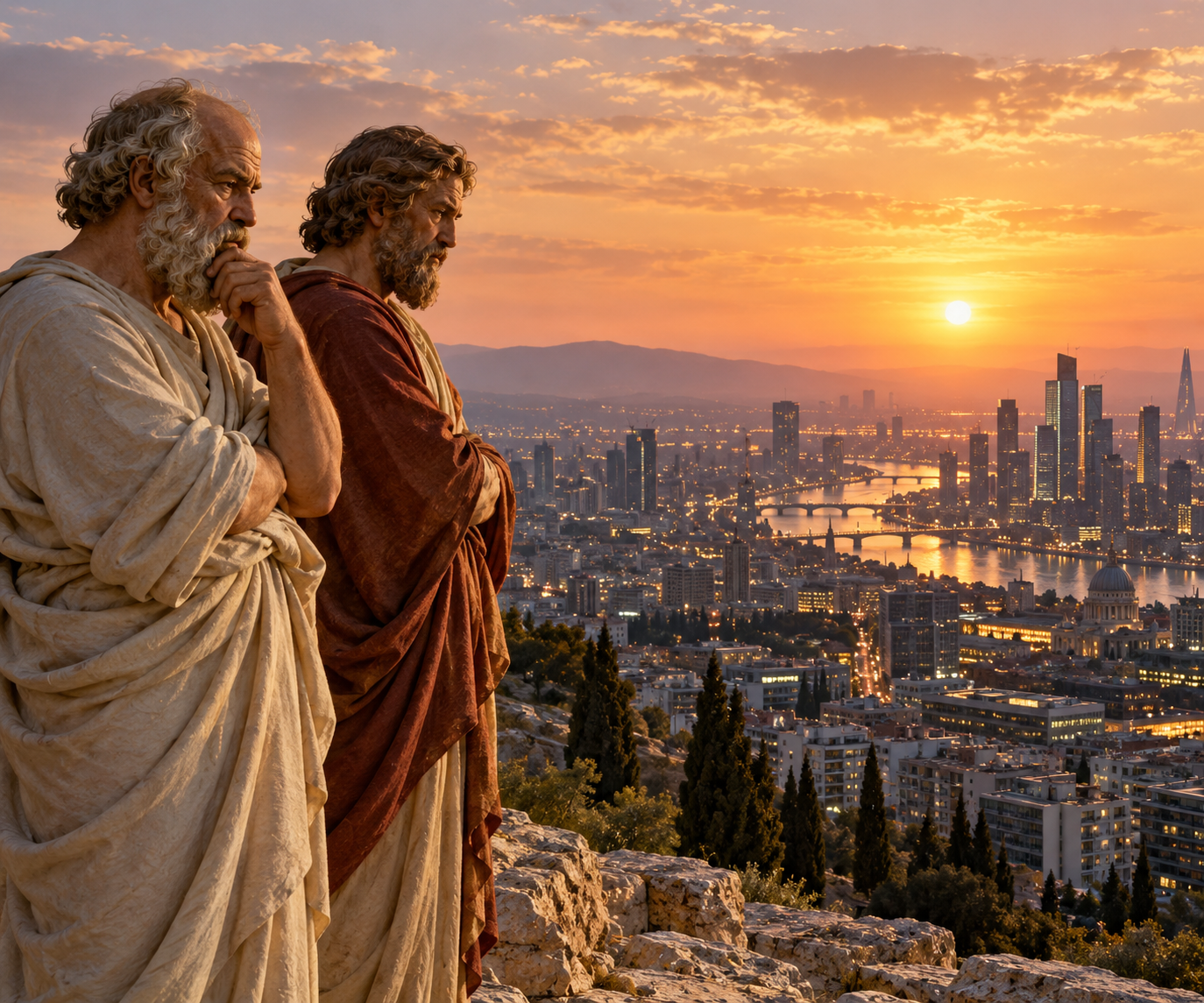
An imagined philosophical examination of humanity in the twenty-first century, drawing upon the surviving dialogues of Plato and the teachings of Socrates.
Nearly two and a half thousand years have passed since Socrates walked through the streets of Athens, questioning its citizens about justice, virtue, wisdom and the good life. His pupil Plato subsequently recorded many of these encounters, developing a philosophy that has influenced Western thought ever since. Neither man could have imagined the extraordinary civilisation that humanity would construct; yet both might recognise, beneath its technological sophistication, the same human weaknesses that troubled ancient Athens.
Suppose they were to return today, not as supernatural judges, but as observers of a civilisation possessing knowledge and powers beyond anything their contemporaries could have conceived. What would they make of our achievements, our institutions, our treatment of one another and our relationship with the natural world? Their first reaction would surely be astonishment. Their second, perhaps, bewilderment. And their third, a question: Has humanity become wiser, or merely more powerful?
The Illusion of Progress
Socrates would be fascinated by our scientific accomplishments. He would encounter machines capable of flight, instruments that reveal the structure of matter, medical interventions that preserve life, and technologies that permit instantaneous communication across continents. He would learn that humanity has walked upon the Moon, examined distant galaxies and begun to understand the biological processes through which life evolved.
But admiration would not prevent him from asking whether these achievements had made human beings better.
In Plato’s Apology, Socrates recounts his encounters with politicians, poets and craftsmen who believed themselves wise. He discovered that expertise in one field frequently encouraged an unwarranted belief in wisdom elsewhere. The craftsman who understood his trade might nevertheless presume to understand justice, morality or government.
Modern civilisation, Socrates might conclude, has magnified this error enormously.
We possess unprecedented technical expertise, yet our ability to distinguish what we can do from what we ought to do remains uncertain. We can manipulate the genetic foundations of life, construct weapons capable of destroying cities and develop artificial intelligence that increasingly performs intellectual tasks once considered exclusively human. But who determines the purposes towards which these powers are directed?
For Socrates, knowledge without an understanding of goodness was insufficient. The important question was not simply whether an action could be accomplished, but whether it contributed to a life worth living.
He might therefore regard modern humanity as extraordinarily accomplished, yet dangerously confused about the meaning of accomplishment itself.
The Cave and the Manufactured World
Plato would perhaps find his most disturbing revelation in the technologies through which modern people perceive reality.
In Book VII of The Republic, he describes prisoners chained within a cave, compelled to watch shadows projected upon a wall. Having never experienced the world beyond, they mistake these shadows for reality. Education, in Plato’s conception, is the difficult process of turning towards the light and learning to distinguish appearance from truth.
The allegory seems almost prophetic when considered alongside contemporary communications.
Billions of people now experience much of the world through screens. Their understanding of events is mediated by corporations, governments, algorithms and individuals competing for attention. Information is selected, presented, repeated and manipulated according to interests that may have little relationship to truth.
The shadows have become extraordinarily convincing.
Plato would recognise that misinformation is not merely the circulation of false statements. It is the construction of an environment in which people gradually lose the ability, or perhaps the inclination, to distinguish evidence from persuasion.
Socrates would be equally troubled by the disappearance of genuine dialogue. His method depended upon patient questioning, reasoned disagreement and the willingness to abandon a cherished belief when its foundations proved unsound.
Modern public discourse frequently rewards the opposite. Certainty is celebrated, doubt interpreted as weakness, and disagreement treated as hostility. The philosopher who acknowledged the limitations of his knowledge might struggle to find an audience among those who confidently proclaim answers to questions they have scarcely considered.
Yet Plato’s allegory contains a further warning. Those who escape the cave and return to explain what they have discovered may encounter ridicule or violence.
A civilisation that mistakes popular opinion for truth may become hostile to those who challenge its assumptions.
Democracy and the Problem of Leadership
Neither philosopher would approach contemporary democracy without reservations.
Socrates lived through the political instability of Athens and was eventually condemned to death by a democratic jury. Plato, profoundly affected by his teacher’s execution, questioned whether political authority should depend upon popularity rather than wisdom.
In The Republic, he argues that government should be entrusted to those who understand justice and possess the character necessary to pursue it. His philosopher-rulers were not intended to be privileged aristocrats seeking personal advantage, but individuals educated to subordinate private ambition to the common good.
Observing modern political systems, Plato might find his concerns vindicated. Political leadership is frequently secured through wealth, publicity, persuasion and the cultivation of popular emotion. Electoral success does not necessarily demonstrate competence, integrity or understanding. Indeed, the qualities required to obtain political power may differ considerably from those required to exercise it wisely. He would recognise in modern demagoguery the dangers described in Book VIII of The Republic, where excessive political appetites and the manipulation of public desires contribute to the degeneration of democracy into tyranny.
Nevertheless, Plato’s own proposed solution presents difficulties that modern civilisation has learned to recognise. Who determines which individuals possess superior wisdom? How can supposedly enlightened rulers be prevented from becoming tyrants themselves?
Socrates might offer the more enduring contribution. Rather than prescribing an infallible political system, he would question its participants. What is justice? What constitutes good government? Should public office confer privilege or responsibility? Can a government claim legitimacy while disregarding the welfare of those it governs? He might conclude that democracy’s greatest weakness is not the participation of ordinary citizens, but the failure to cultivate the judgement necessary for meaningful participation.
Wealth, Consumption and the Disordered Soul
The material abundance of contemporary civilisation would present another profound contradiction. Humanity produces sufficient resources to provide the necessities of life on a scale unimaginable in antiquity. Yet enormous inequalities persist. Some individuals possess wealth exceeding the economic resources of entire communities, while others lack adequate food, shelter, sanitation or medical care.
Plato would examine this condition through his understanding of the soul.
In The Republic, he distinguishes reason, spirit and appetite. A just individual is one in whom reason governs, with spirit supporting its judgement and appetite accepting appropriate limits. When appetite becomes dominant, the individual loses internal harmony. Plato extends this principle to the organisation of society.
A civilisation organised principally around acquisition, consumption and competition might therefore represent, in his eyes, a collective disorder of the soul. Its inhabitants are encouraged to desire continually more, irrespective of whether their existing possessions provide comfort, security or happiness. Economic success is measured through expanding production and consumption, while restraint is frequently interpreted as failure.
Socrates, whose personal life was notably indifferent to material luxury, would ask a simpler question. How much is enough?
In Plato’s Gorgias, Socrates challenges the notion that happiness consists in satisfying an endless succession of desires. A life governed by insatiable appetites cannot achieve lasting contentment because satisfaction continually retreats before the next demand. Modern consumer society appears almost deliberately constructed around the perpetuation of this dissatisfaction. The tragedy, both philosophers might suggest, is that humanity has mistaken the accumulation of possessions for the cultivation of a good life.
Humanity and the Natural World
Perhaps the most consequential revelation would concern humanity’s relationship with the Earth, beginning with the extraordinary multiplication of its own numbers.
When Plato and Socrates walked the streets of Athens, the entire human population of the planet probably numbered no more than a few hundred million. Today, more than eight billion people inhabit the Earth, an increase of a magnitude that neither philosopher could reasonably have imagined.
They would encounter vast cities containing more inhabitants than entire ancient kingdoms, immense agricultural systems dedicated to feeding them, and industrial enterprises extracting resources from almost every accessible region of the planet. Socrates would surely begin with a question. Can any population, however ingenious its members, continue expanding indefinitely within a world whose physical resources are finite?
The ancient Greeks possessed no understanding of industrial carbon emissions, anthropogenic climate change or the accelerating destruction of biological diversity. Nevertheless, Plato and Socrates inhabited a philosophical tradition concerned with proportion, order, moderation and the consequences of excess.
Plato would also encounter evidence that environmental degradation was not entirely unfamiliar to his own civilisation. In the Critias, he describes the erosion and deforestation of Attica, contrasting its diminished landscape with an earlier period of greater fertility.
He understood, at least in part, that human activity could impoverish the land upon which communities depended. What would astonish him today would be the scale. Every additional human life requires a share of the Earth’s biological productivity. Yet the burden imposed upon nature is determined not simply by how many people exist, but by how they live. A society that demands ever-increasing material consumption multiplies the consequences of population growth, while technological improvements may reduce some pressures even as they create others.
Humanity has become capable of altering planetary systems, exhausting fisheries, destroying forests, contaminating oceans and changing atmospheric chemistry. Its technological achievements have enabled it to overcome many immediate natural constraints while simultaneously undermining the ecological foundations of its existence.
Socrates would undoubtedly question the reasoning behind such behaviour.
If a farmer destroyed the fertility of his soil to obtain one exceptional harvest, would we call him wise? If a community poisoned its water to increase its wealth, would we regard it as prosperous? And if a population exceeded the capacity of its environment to sustain it without progressive degradation, would it be reasonable to celebrate its continued expansion as an achievement? Plato might interpret this as the ultimate failure of reason to govern appetite. The pursuit of immediate advantage has overwhelmed consideration of the whole.
Neither philosopher could simply be described as a modern environmentalist. Their surviving works do not establish a comprehensive ecological ethic. Yet their insistence upon moderation, rational judgement and the distinction between genuine and apparent goods provides a powerful basis for questioning humanity’s present course.
Perhaps they would recognise a contradiction that modern civilisation has been reluctant to confront: that improvements in human welfare, medicine and longevity have contributed to the extraordinary growth of our species, while the cumulative demands of that success increasingly challenge the natural systems upon which future generations depend.
The question, therefore, is not simply how many human beings the Earth can support, but how many it can support well, for how long, and at what cost to the countless other forms of life with which we share it. A civilisation cannot reasonably claim wisdom while knowingly diminishing its own prospects for survival.
War, Power and the Failure of Justice
Both philosophers would recognise warfare immediately. Ancient Greece was characterised by rival city-states, military alliances, imperial ambitions and recurring conflicts. Socrates himself served as a soldier during the Peloponnesian War. Yet modern warfare would confront them with an appalling transformation.
The weapons of antiquity required proximity between combatants. Modern weapons can destroy entire communities from enormous distances, while nuclear arsenals possess the capacity to inflict devastation far beyond the battlefield. Plato would recognise the continuing influence of ambition, fear and the desire for domination. In The Republic, he associates the expansion of luxurious desires with territorial competition and the origins of war.
Modern civilisation has multiplied both the incentives and the instruments of conflict. Socrates would ask whether military superiority constitutes moral superiority. Does victory establish justice? Can the deliberate destruction of innocent lives become virtuous merely because it serves the interests of a state? In the Crito, Socrates argues against returning injustice for injustice, even when one has suffered wrongdoing. His position was uncompromising: moral obligations cannot simply be discarded because circumstances make wrongdoing advantageous.
Applied to international relations, this principle would challenge the assumption that national interest alone can justify violence.
Both philosophers might find it extraordinary that humanity devotes immense intellectual and material resources to preparing for wars while struggling to provide universally for the elementary necessities of peaceful existence. They would not necessarily agree about the means of preventing conflict. Plato’s ideal state retains a military class, while Socrates’ own service demonstrates that neither can simply be enlisted as an advocate of absolute pacifism. Nevertheless, they would surely insist that power must remain subordinate to justice.
Education and the Purpose of Civilisation
The philosophers’ most sustained criticism might ultimately concern education. For Plato, education was not merely the transmission of useful information. It was the cultivation of character and the gradual development of the capacity to recognise truth and goodness. Socrates understood philosophy as an activity inseparable from everyday life. In the Apology, he declares that the unexamined life is not worth living.
Modern education, by contrast, is frequently evaluated according to economic usefulness. Institutions are encouraged to produce employable individuals equipped with skills demanded by contemporary markets. Such skills are necessary, but they do not constitute wisdom. A person may be an accomplished engineer, physician, economist or administrator while remaining profoundly ignorant of ethics, history, political responsibility or the consequences of their actions.
Plato would question a civilisation that invests heavily in training people to operate its machinery but comparatively little in teaching them to examine the purposes that machinery serves. Socrates would ask whether young people are being educated to think independently or merely prepared to participate efficiently in an existing system. Neither would regard the accumulation of information as equivalent to understanding. They might suggest that the most important purpose of education is to develop individuals capable of questioning the assumptions upon which their civilisation depends.
Without that capacity, even the most sophisticated society risks becoming intellectually obedient to its own mistakes.
A Final Conversation
Imagine, finally, the two philosophers standing upon a hillside overlooking a modern city.
Before them stretches an extraordinary achievement: hospitals, universities, transport networks, illuminated buildings and countless manifestations of human ingenuity. Beyond the horizon lie industrial landscapes, depleted ecosystems and the machinery of warfare. Above them, satellites circle a planet whose inhabitants have acquired unprecedented powers without establishing any corresponding agreement about how those powers should be exercised.
Plato might reflect that humanity has constructed a civilisation of remarkable complexity without achieving the harmony necessary to sustain it. Socrates, characteristically, would be less inclined to pronounce judgement than to ask questions.
What is the purpose of civilisation? Is it to increase wealth, extend power and satisfy desire? Or is it to create the conditions in which human beings may live well, treat one another justly and preserve the world upon which their existence depends? And if the latter, why do so many of our institutions reward behaviour that defeats those purposes?
The philosophers would not possess ready answers to every contemporary problem. Their own assumptions, particularly concerning slavery, hierarchy, citizenship and the position of women, would themselves require rigorous examination. We should not imagine that wisdom from antiquity is immune to criticism merely because it has survived. Their enduring contribution lies elsewhere. They remind us that civilisation is not defined by the sophistication of its instruments, the magnitude of its wealth or the extent of its power. Its worth must ultimately be judged by the purposes it serves and the quality of the lives it makes possible. Humanity has learned to transform almost everything around it.
The question Socrates and Plato would leave us with is:
Is the defining failure of modern civilisation a lack of knowledge, or an inability to translate knowledge into wisdom?
NB This essay is an imaginative reconstruction, not an attribution of modern opinions directly to either philosopher. Socrates left no surviving writings of his own; the principal accounts come from Plato, Xenophon and Aristophanes. Plato’s dialogues, especially the earlier works, do not always allow us to distinguish the historical Socrates from Plato’s developing philosophy.
The principal texts informing the essay are:
Plato, Apology (21b–23b; 29d–30b; 38a): Human ignorance, the examination of life, and the relationship between virtue and wealth.
Plato, Republic (Books II, IV, V, VII and VIII): Luxury and warfare, justice and the ordered soul, philosopher-rulers, the cave, education and the degeneration of political systems.
Plato, Gorgias (491d–507c): Appetite, self-control, rhetoric and the nature of the good life.
Plato, Crito (49a–49e): The principle that suffering injustice does not justify committing injustice.
Plato, Critias (111a–111d): The deterioration of Attica’s landscape through the loss of soil and vegetation.


